
COURSE OVERVIEW
DE0609 : Rock Physics - Integrating Petrophysical, Geomechanics, and Seismic Measurements
OVERVIEW
| COURSE TITLE | : | DE0609 : Rock Physics - Integrating Petrophysical, Geomechanics, and Seismic Measurements |
| COURSE DATE | : | Aug 10 - Aug 14 2026 |
| DURATION | : | 5 Days |
| INSTRUCTOR | : | Dr. Chris Kapetan |
| VENUE | : | Virtual Course |
| COURSE FEE | : | $ 4000 |
Course Description
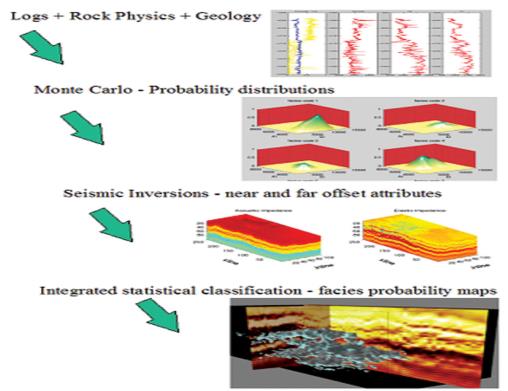
Rock Physics is a key component in oil and gas exploration, development and production. It combines concepts and principles from geology, geophysics, petrophysics, applied mathematics and other disciplines. Rock physics provides the empirical relationships, understanding and theory to connect petrophysical, geomechanical and seismic data to the intrinsic properties of rocks, such as mineralogy, porosity, pore shapes, pore fluids, pore pressures, stresses and overall architecture, such as laminations and fractures.
Rock physics is needed to optimize all imaging and reservoir characterization solutions based on geophysical data, and to such data to build mechanical earth models for solving geomechanical problems. An in depth understanding of rock and fluid physics is crucial for any successful seismic attribute interpretation as well as substantially reducing drilling risk. Seismic petrophysics aims to quantitatively link rock properties with reservoir petrophysical properties. This knowledge then allows for careful attribute screening and the creation of rock physics models properly calibrated to local/regional well data, which could then be used to forward model the seismic response. In order to construct geologically realistic rock physics models, the rock physicist needs to be able to identify and correct anomalous and/or missing data from a petrophysical wireline analysis.
This course is designed for participants to understand the sensitivity of elastic waves in the earth to mineralogy, porosity, pore shapes, pore fluids, pore pressures, stresses, and the anisotropy of the rock fabric resulting from the depositional and stress history of the rock, and how to use this understanding in quantitative interpretation of seismic data and in the construction of mechanical earth models.
The course will provide a basic understanding of the relations between elastic and reservoir properties of rocks and demonstrate how rock physics is used to interpret and analyze seismic data. A variety of applications and real data examples is presented. Various rock physics models will be covered and the validity of these models to particular geological scenarios will be discussed.
TRAINING METHODOLOGY
This interactive training course includes the following training methodologies:
LecturesPractical Workshops & Work Presentations
Hands-on Practical Exercises & Case Studies
Simulators (Hardware & Software) & Videos
In an unlikely event, the course instructor may modify the above training methodology for technical reasons.
VIRTUAL TRAINING (IF APPLICABLE)
If this course is delivered online as a Virtual Training, the following limitations will be applicable:
| Certificates | : | Only soft copy certificates will be issued |
| Training Materials | : | Only soft copy materials will be issued |
| Training Methodology | : | 80% theory, 20% practical |
| Training Program | : | 4 hours per day, from 09:30 to 13:30 |
RELATED COURSES
DE0364 : Artificial Lift Methods (WSG)
- Date: Oct 18 - Oct 22 / 3 Days
- Location: Doha, Qatar
- Course Details Register
.jpg)
DE0251(AD6) : Production Operations in the Oil & Gas Fields & Surface Facilities: Operation of Process Equipment, Separation of Oil/Gas/Water, Controlling Flow/Pressure/Temperature, Injection of Water/Gas & Process Troubleshooting
- Date: Oct 18 - Oct 22 / 3 Days
- Location: Doha, Qatar
- Course Details Register

DE0407 : Field Development and Business Planning
- Date: Oct 18 - Oct 22 / 3 Days
- Location: Doha, Qatar
- Course Details Register
DE0512 : Operating Production Wells & Associated Equipment
- Date: Oct 18 - Oct 22 / 3 Days
- Location: Doha, Qatar
- Course Details Register