
COURSE OVERVIEW
DE0403-3D : Petroleum Geostatistics - Integrating Data for Reservoir Modeling and Simulation
OVERVIEW
| COURSE TITLE | : | DE0403-3D : Petroleum Geostatistics - Integrating Data for Reservoir Modeling and Simulation |
| COURSE DATE | : | Aug 03 - Aug 05 2026 |
| DURATION | : | 3 Days |
| INSTRUCTOR | : | Ms. Diana Helmy |
| VENUE | : | Abu Dhabi, UAE |
| COURSE FEE | : | $ 5250 |
Course Description
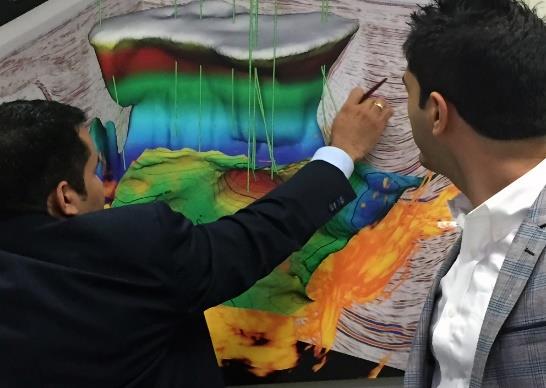
This course is designed to provide participants with a detailed and up-to-date overview of Petroleum Geostatistics - Integrating Data for Reservoir Modeling and Simulation. It covers the scope of geostatistics in petroleum engineering; the importance of geostatistics for reservoir modeling, applications in oil and gas exploration and development and integration with other disciplines; the fundamentals of reservoir data types covering geological data, geophysical data, reservoir production data and uncertainty and quality of data; and the concepts of heterogeneity and anisotropy, variogram theory, types of variograms and applications of variograms in reservoir modeling.
Further, the course will also discuss the data analysis techniques, histograms, cumulative distributions and cross-plots, normalization; the transformation of reservoir data and detecting outliers ad data inconsistencies; the geostatistical modeling tools and variogram analysis and modeling; the geostatistical data integration and kriging techniques for reservoir estimation; the methods of spatial interpolation in reservoirs; and the advantages and disadvantages of each method.
During this interactive course, participants will learn the sequential gaussian simulation (SGS) and its role in uncertainty quantification; the facies modeling, sequential indicator simulation (SIS) and lithology prediction from well logs; the seismic-to-facies transformations, stochastic and deterministic methods and incorporating seismic attributes into facies models; the fundamentals of multi-point geostatistics (MPS) for complex geological patterns; the petrophysical property modeling, conditional simulations and data conditioning techniques; quantifying and visualizing uncertainty in reservoir modes and probabilistic modeling approaches; the advanced geostatistical techniques, full-field reservoir modeling workflow, history matching and production data integration; validating reservoir models, the sensitivity analysis for model parameters and calibration using production and pressure data; the reservoir simulation workflows, linking static models to dynamic simulators and simulation outputs and interpretation; using geostatistical models for field development planning; the high-uncertainty zones for further exploration; and the risk assessment and mitigation strategies.
TRAINING METHODOLOGY
This interactive training course includes the following training methodologies:
LecturesPractical Workshops & Work Presentations
Hands-on Practical Exercises & Case Studies
Simulators (Hardware & Software) & Videos
In an unlikely event, the course instructor may modify the above training methodology for technical reasons.
VIRTUAL TRAINING (IF APPLICABLE)
If this course is delivered online as a Virtual Training, the following limitations will be applicable:
| Certificates | : | Only soft copy certificates will be issued |
| Training Materials | : | Only soft copy materials will be issued |
| Training Methodology | : | 80% theory, 20% practical |
| Training Program | : | 4 hours per day, from 09:30 to 13:30 |
RELATED COURSES
DE0512 : Operating Production Wells & Associated Equipment
- Date: Oct 18 - Oct 22 / 3 Days
- Location: Doha, Qatar
- Course Details Register
.jpg)
DE0251(AD6) : Production Operations in the Oil & Gas Fields & Surface Facilities: Operation of Process Equipment, Separation of Oil/Gas/Water, Controlling Flow/Pressure/Temperature, Injection of Water/Gas & Process Troubleshooting
- Date: Oct 18 - Oct 22 / 3 Days
- Location: Doha, Qatar
- Course Details Register

DE0407 : Field Development and Business Planning
- Date: Oct 18 - Oct 22 / 3 Days
- Location: Doha, Qatar
- Course Details Register

DE0364 : Artificial Lift Methods (WSG)
- Date: Oct 18 - Oct 22 / 3 Days
- Location: Doha, Qatar
- Course Details Register